

Can of Corn
How a General Store Clerk’s Routine Became Baseball’s Most American Phrase

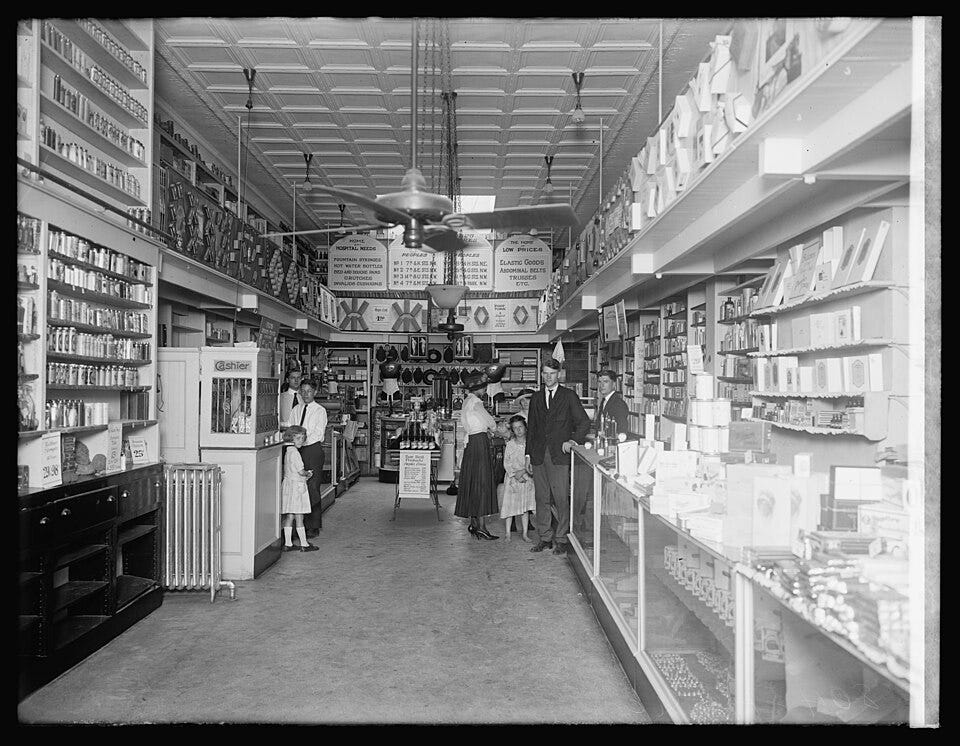
Imagine the store before you walk in.
It is 1893, somewhere in rural America, though it could be a dozen states and a hundred towns. A small frame building, probably on the main road, probably near the post office because the post office is often inside it. The sign above the door has the owner’s name. The windows are crowded with goods arranged to catch passing eyes. You push open the door and the smell hits you first: coffee beans, sawdust, tobacco, dried herbs, and the faint iron tang of hardware.
The shelves run floor to ceiling on every wall. There is no space here that does not work for a living. Bolts of calico are stacked next to jars of penny candy. Kerosene lanterns hang from ceiling hooks alongside washboards and cast iron pans. Behind the long wooden counter, a clerk in a white apron moves with the practiced efficiency of someone who has memorized every inch of this space.
Your eyes go up. Near the ceiling, on the highest shelves, the canned goods are arranged in uniform rows, their paper labels bright against the dark wood. Corn, tomatoes, peaches, beans. You tell the clerk what you need. He reaches for a long wooden stick with a metal hook at the end, tips a can of corn off the shelf, and catches it cleanly in his outstretched apron as it falls.
He does not even look at his hands. He is already looking back at you, ready for the next item on your list. The catch is so routine it barely registers as a physical act. It is simply what you do when someone needs corn.
Somewhere, a visiting sportswriter or a ballplayer on a road trip was watching. And the language of baseball got a little richer.
⚾⚾⚾
The phrase “can of corn” first appears in baseball writing in 1896. It means an easy fly ball, the kind that settles so gently into an outfielder’s glove that the fielder seems to be waiting for it rather than chasing it. The Dickson Baseball Dictionary, the definitive scholarly resource on baseball language, traces the first documented usage to that year and identifies the general store image as the most accepted explanation: a grocer using a hooked stick to tip a can off a high shelf and catch it in his apron, the motion practiced, unhurried, and entirely without drama.
That much most baseball fans have heard, if they have heard the story at all.
But the phrase is more interesting than that brief summary suggests. It is more historically layered, more culturally specific, and more revealing about the America that created baseball than any single-sentence origin story can hold. To understand where “can of corn” came from is to understand something about who was watching baseball in the 1890s, where they lived, what their daily lives looked like, and how the language of commerce and agriculture bled naturally into the language of sport.
It is, in other words, a fossil. And like any fossil, what it preserves is not just an artifact, but the outline of a vanished world.
⚾⚾⚾
The world was vanishing even as the phrase was being coined.
In 1896, the same year “can of corn” first appeared in print, the United States Postal Service introduced Rural Free Delivery, bringing mail directly to farmhouses and small-town homes for the first time. That single change began the slow erosion of the general store’s central role in American rural life, because the store had always been the place where you picked up your mail and your news. Once the mail came to your porch, one major reason to make the trip into town disappeared.
Then came the catalogs. Montgomery Ward had been operating since 1872. Sears launched its massive catalog operations in 1893, three years before “can of corn” entered the written record. Rural families who had previously depended on the general store for everything from fabric to farm implements could now browse hundreds of pages of goods and order by mail.
The clerk with the hooked stick was already becoming an anachronism. The high shelves and the long white apron were already on their way to being memory.
This is what fossils do. They form at the boundary between presence and absence, hardening into stone just as the living thing disappears. “Can of corn” became fixed in language just as the general store was softening into decline. By the time the phrase was fully established in the baseball vocabulary, the practice it described was fading from daily American life.
By the time I heard it from a Little League coach in Minnesota, nobody in the dugout had any idea where it came from.
That is not a failure of knowledge; that is how language works. The phrase outlived its origin by a century because it was too good, too precise, and too perfectly suited to the thing it described to be discarded just because the reference had become opaque.
⚾⚾⚾
Before you can fully appreciate the phrase, you need to understand what canned corn meant to Americans in the 1890s.
Canned corn was not a minor grocery item. It was one of the foundational products of the American canning industry, which itself was one of the great industrial achievements of the nineteenth century. The Winslow brothers of Portland, Maine, opened the first successful corn canning factory in the United States in 1852, and within a generation the industry had spread across the country. By the 1880s, improved manufacturing had put preserved vegetables on the shelves of general stores from New England to the Great Plains, available to anyone in every season.
In Minnesota, sweet corn canneries opened in Austin and Mankato in the early 1880s, followed by factories in Faribault, Owatonna, and LeSueur. Corn was not an abstraction in the communities where baseball was taking root. It was a local product, grown nearby, processed nearby, and stacked on the shelves of every grocery in the region. When a baseball writer in 1896 reached for the image of a falling can to describe an easy fly ball, his readers knew exactly what he meant because they had seen it that week.
That specificity matters. The phrase did not emerge from a vague agricultural culture. It emerged from a precise commercial transaction, repeated thousands of times a day across small-town America. The clerk did not think about the catch and the customer did not watch it. It simply happened, the way a lazy fly ball settles into an outfielder’s hands while he is already thinking about the next play.
Furthermore, corn was the best-selling vegetable in the store, which meant those cans were the ones grabbed most often. The catch was not just easy in the abstract. It was the easy catch made constantly, repeatedly, and without variation. It was the routine made routine.
⚾⚾⚾
There is a second theory, and it is not in competition with the first so much as in conversation with it.
In the early days of organized baseball, particularly in rural areas, the outfield was commonly called the cornfield. This was not always metaphorical. Many of the early baseball grounds in small towns were simply cleared spaces at the edge of farms, and the outfield fence was sometimes literally the border of a working cornfield. A ball hit softly to the outfield went into the corn, in both senses. A lazy fly ball that settled into the grass without drama was a cornfield fly, a harvest rather than a catch.
From “cornfield fly” to “can of corn” is not a large linguistic leap. The store brought the farm to the shelf; the phrase may have traveled the same route, moving from the literal cornfield outfield to the commercial image of the clerk and the falling can. The two origins reinforced each other because they drew on the exact same cultural landscape.
What that landscape looked like is worth holding in your mind: steel towns and farming communities, small-town general stores and semi-rural baseball grounds. Fans who had grown up on farms sat in wooden grandstands watching a game that had organized itself around the rhythms of the agricultural calendar. The World Series is played in October because October is after harvest. That is not an accident. Baseball was built by and for people who understood the year in terms of what the ground produced. The language of the sport reflects that understanding in dozens of ways, and “can of corn” is one of the most direct.
⚾⚾⚾
The phrase might have remained a regional curiosity, known only to local players and the sportswriters who covered them, without the intervention of one man who understood that language was a vehicle for memory.
Walter Lanier “Red” Barber was born in Columbus, Mississippi, in 1908, and raised in Sanford, Florida. He started his broadcasting career at the University of Florida in 1930 and called his first major league game on Opening Day in 1934 for the Cincinnati Reds. In 1939, he moved to Brooklyn to broadcast Dodgers games, and for the next fifteen years he became an institution in one of the most particular places in American sports geography.
Brooklyn was the opposite of rural America: dense, immigrant, working-class, loud, and fiercely local. Red Barber was a Southern gentleman with a drawl that belonged in a different country from Ebbets Field. And yet it worked, because Barber understood that broadcast language is not just description, it is atmosphere. The atmosphere he created was warm, unhurried, and rooted in a world his listeners recognized even if they had never lived in it themselves.
His signature phrases were a catalog of rural American imagery. He described a team on a winning streak as “tearin’ up the pea patch.” He called a one-sided game “tied up in a croker sack.” He said a close game was “tighter than a new pair of shoes on a rainy day.” And when a fly ball hung in the air long enough for an outfielder to drift underneath it, he said it was a can of corn.
Barber was doing something that went beyond colorful announcing. He was translating rural American language into urban broadcast media at the exact moment when millions of Americans who had grown up in small towns were moving into cities. The children and grandchildren of general store customers were sitting in Brooklyn apartments listening to the radio, and Red Barber was handing them phrases that connected their present to their parents’ world.
The phrase survived Barber. It passed to other broadcasters, other booths, and other cities. Hawk Harrelson made it his own in Chicago; Bob Prince used it in Pittsburgh. It filtered down from the major leagues to the minors, from amateur ball to little league fields in every state in the country. By the time it reached a volunteer coach in Minnesota, it had traveled through sixty years of broadcast history and a hundred years of American commercial life, arriving stripped of context but carrying its perfect shape.
⚾⚾⚾
He was not a memorable coach, the man who first said it to me. I could not tell you his name or what he looked like. I just remember the dugout, the smell of cut grass and infield dirt, and the particular quality of a summer afternoon when you are ten years old and the game is the entire world.
He used the phrase the way adults use phrases they have always known: without introduction, without definition, and without any indication that it required explanation. A fly ball went up, he said “can of corn,” and everybody nodded. We had all heard it before, from someone who had heard it before, going back in an unbroken chain to a Brooklyn radio booth, to a Mississippi-born broadcaster, to a sportswriter in 1896 who watched a clerk in a white apron tip a can off a high shelf and thought: *that is exactly what that looks like.*
The clerk is long gone. The store is long gone. The America that made both of them possible is long gone, replaced by supermarkets and delivery apps and a commercial world so different from the general store that the hooked stick might as well be an artifact from an ancient civilization.
The phrase remains.
That is what a fossil does. It carries the past forward without announcing itself, embedded in the speech of people who have no idea they are speaking another century’s language. You use it, and somewhere in the word is a store you have never visited, a clerk you have never met, and a world that was already disappearing the year the phrase was born.
Baseball has hundreds of these. “Can of corn” is just the one that takes you all the way back to the shelf.
⚾⚾⚾
*“Can of Corn” is the first essay in a planned collection examining the hidden history of American life through the language baseball invented.*
Cal Raleigh is in a commercial this year for an insurance company. He says working with this company is a can of corn, and tells the young couple it means easy. then he hard-tosses a can of corn right at the lady who catches it in a bit of quality video editing.
https://www.youtube.com/watch?v=6Bx_e_ncuOw
Glad you wrote this, I didn't know that's where it came from.
Can of corn works for all of the reasons you mentioned and because it is short and alliterative. Can of beans just doesn’t have the same ring to it. Red would have known that.